
How often should a home alarm system be serviced?
How often should a home alarm be serviced? Learn NorthTech's recommended interval, what should be tested and which warning signs need earlier attention.
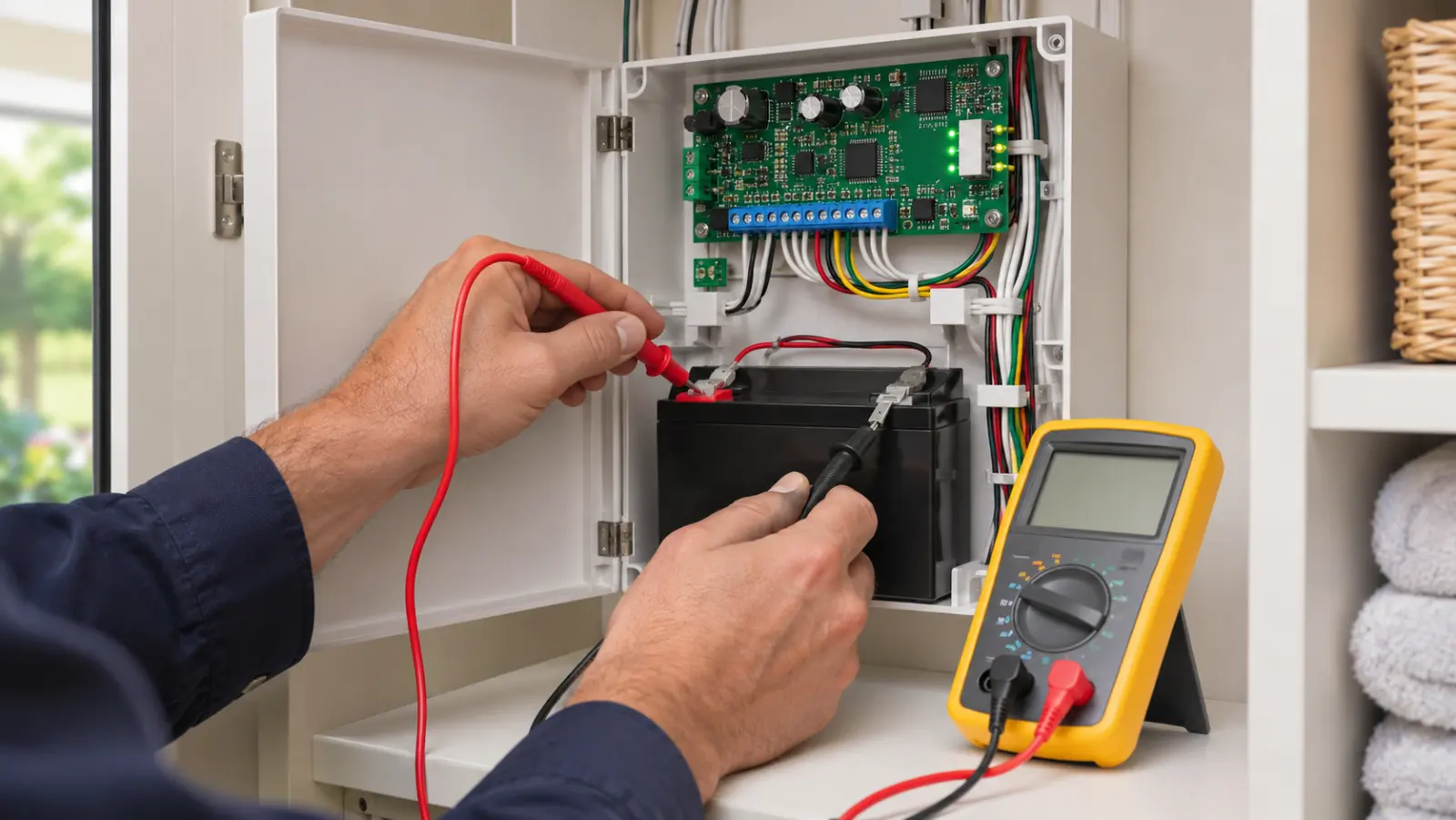
Short answer
Short answer
NorthTech recommends having a typical home alarm professionally serviced at least every two years. NorthTech Care includes an annual system service. Do not wait for the next scheduled service if the keypad displays a battery, tamper, power or communication fault; a detector or door contact stops responding; the alarm repeatedly activates without an obvious cause; or the property, monitoring service or internet equipment changes.
A service should test the complete alarm
An intruder alarm is a chain of equipment and people. The panel, keypad, detectors, door and window contacts, sirens, backup battery, communications, monitoring instructions and app access all contribute to the result.
A proper service should test that complete chain. It should not finish after clearing a warning from the keypad. The technician should confirm that the protected areas respond, warning devices operate, backup power is healthy and an alarm signal reaches the place it is meant to reach.
The two-year interval is NorthTech's recommendation for a typical residential system, not a universal legal requirement. A heavily used, monitored, commercial or higher-risk system may need attention more frequently.
Automatic checks do not replace servicing
Modern alarm panels supervise parts of their own operation. Ness says its main panel batteries are automatically tested every hour and whenever the system is armed. Ness panels can also report power, battery, wireless-device, tamper and communication faults.
These checks are useful, but they cannot inspect everything around the panel. An automatic test cannot walk through every room, operate each protected door, assess a detector's position, hear the siren throughout the property or confirm that the household understands the response procedure.
Furniture, renovations, dust, insects, pets, damaged cabling, a new internet router or a monitoring-account change can affect the system without creating one obvious panel fault.
Official source: Ness: alarm monitoring signals and responses(opens in a new tab)
What should be checked during an alarm service?
The exact work depends on the panel, detectors, communications equipment and monitoring arrangement. For a typical home, the service should establish:
- Panel and keypad: review displayed faults, alarm history, time and date, excluded zones and the physical condition of accessible equipment.
- Backup power: test the panel battery under load and check its charging and connections rather than relying only on its age.
- Detectors and contacts: walk-test motion detectors and operate protected doors and windows so each zone is identified and responds as intended.
- Wireless equipment: check radio supervision, signal reliability and battery warnings for detectors, remotes and other supported devices.
- Warning devices: test the internal and external sirens, strobe and tamper functions in a controlled way.
- Communications: confirm the reporting path, monitoring test signals, app connection and any cellular communicator the household depends on.
- People and access: review current remotes, app users, monitoring keyholders and response instructions without recording private codes.
- The property: check whether changed rooms, doors, windows, pets, heating, air movement or renovation work have altered the protection required.
Arrange an earlier service when the system gives you a reason
The two-year recommendation is not a reason to live with a warning or unreliable protection until the next due date. Arrange an earlier assessment when:
- The keypad beeps or displays a battery, power, tamper, line or communication fault.
- A detector or protected door does not respond normally.
- A zone repeatedly remains open or needs to be excluded.
- The alarm activates without an obvious cause.
- A siren, keypad, remote or app behaves differently from normal.
- The alarm has not been used for a long time and nobody knows its present condition.
- Doors, windows, walls, heating, pets or room layouts have changed.
- The NBN service, router, cellular communicator, monitoring provider or app account has changed.
- Someone has moved in or out and access or monitoring contacts need review.
- Nobody can explain what will happen after an alarm signal is sent.
Official source: Ness: D8X and D16X user manual(opens in a new tab)
What can you check between services?
Pay attention to warning messages and whether doors and windows show their expected state before arming the alarm. If something unusual happens, record the date, time, displayed message and affected zone. That information is more useful to a technician than saying the alarm sometimes beeps.
Keep detectors unobstructed and avoid painting, covering or moving alarm equipment. Do not open the control panel or alter its wiring. Victoria Police defines a security equipment installer as a person retained to install, repair, service or maintain equipment including security alarms and intrusion detectors.
For a monitored alarm, contact the control room before deliberately testing alarm, tamper or bypass conditions. Confirm the correct testing process first so the check does not start an unwanted response.
Official source: Victoria Police: private security licence activities(opens in a new tab)
Alarm servicing and smoke-alarm maintenance are different
Servicing a security system does not automatically satisfy the separate maintenance requirements for smoke alarms or a commercial fire-alarm system. Even when a smoke detector is connected to an intruder-alarm panel, its fire-safety purpose needs the correct test and maintenance process.
The Country Fire Authority recommends testing Victorian household smoke alarms every month and cleaning them every year. A smoke alarm with a replaceable 9-volt battery needs that battery changed annually, and every smoke alarm should be replaced after 10 years. Follow the manufacturer's instructions and the requirements that apply to the property.
Official source: Country Fire Authority: smoke alarm maintenance(opens in a new tab)
A good service should leave a clear record
After the service, the household should know which panel and communication equipment are installed, which zones and warning devices were tested, whether the backup battery passed or was replaced, whether monitoring and app communication were confirmed, which faults still need attention and when the next service is due.
The report should explain what was tested without recording alarm codes, voice codes or other private access credentials. That gives the next technician a useful history while keeping access information private.
Related alarm advice
- Why does my home alarm keep going off?Record the event details safely and understand why bypassing a zone is not a repair.
- Should an older alarm panel be repaired or replaced?Consider the complete system, available support and recurring faults before deciding.
- Does alarm monitoring need a landline?See how modern 4G reporting, backup power and the monitoring response work together.
- Compare NorthTech alarm systemsReview the Ness alarm choices NorthTech designs, installs, monitors and supports.
Want advice for your property?
Tell us what you are planning or what is already installed. We’ll give you a clear next step.